
Instructional design
Instructional design for HSE: put ADDIE to work
A practical method for connecting workplace needs, learning objectives, activities and assessment before building the slides.
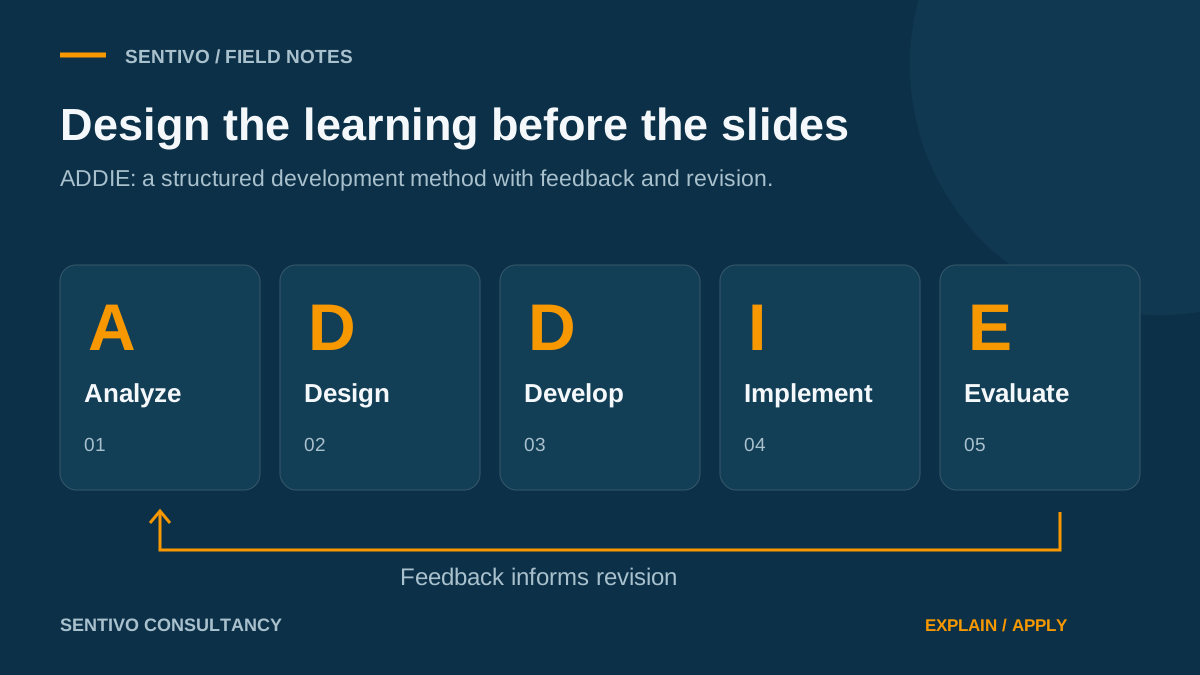
When an HSE course begins with a blank PowerPoint file, the first decision is often about layout. Instructional design asks an earlier question: what should people be able to do after training, and what evidence will show that they can do it?
CDC describes ADDIE as five stages: Analyze, Design, Develop, Implement and Evaluate. Each stage produces a deliverable and allows feedback and revision. OSHA also presents ADDIE as one model for systematic worker-training development. Neither source establishes it as the only acceptable model. [1] [3]
Analyze: establish the actual need
CDC’s quality standards begin by checking whether training is needed. Training is not always the solution to a performance gap. The standards also call for identifying learners, goals and delivery barriers. [2]
Sentivo application: imagine that permit reviews repeatedly find incomplete task descriptions. Before commissioning a course, examine examples and speak with users. Is the problem lack of knowledge, unclear instructions, an unsuitable form or a combination? Record the evidence, the affected roles and the part that training can reasonably address.
Design: connect objectives and evidence
CDC calls for measurable learning objectives and educational methods that support them. OSHA similarly advises defining what the participant should be able to do differently after training. [2] [3]
For the permit example, a proposed objective is: “Given a fictional work request and the approved procedure, identify missing task information and explain the required next action.” The matching assessment is a work-request review with agreed marking criteria. A question asking learners to recall the definition of a permit would test a different outcome.
Develop: build a coordinated package
CDC’s standards include accurate, relevant content, subject matter expert review and opportunities for feedback. [2]
Sentivo application: develop the scenario, answer key, trainer prompts and learner reference sheet together. Use the approved company procedure to resolve technical questions. Keep slide references and revision details traceable. Pilot the task instructions with someone representative of the audience before producing the final package.
Implement: prepare the conditions for learning
The implementation stage puts the planned training into use. CDC’s standards also require considering delivery barriers and usability. [1] [2]
For this example, the delivery plan should specify who facilitates the exercise, how participants access the procedure, how answers are collected and how questions outside the trainer’s authority are escalated. For online delivery, rehearse the activity using the actual platform and screen layout.
Evaluate: use findings to revise the course
CDC recommends evaluating the training and aligning learner assessments with objectives. Its standards also include follow-up support and consideration of delayed evaluation. [2]
Sentivo application: examine which missing details learners recognised and which they overlooked. Revise ambiguous instructions or weak explanations. Where appropriate, agree a later review of workplace examples to explore whether the learning is being used.
A useful design record
Sentivo recommends keeping a short record linking each objective to its source, teaching method, practice task and assessment criterion. This is an implementation suggestion, not an additional ADDIE stage. It gives the reviewer a concrete way to check whether the training package supports the intended workplace outcome.
Sources
References were checked on 30 October 2026. Numbered links connect factual claims to these sources. Examples, checklists and proposed applications identified as Sentivo’s are editorial recommendations; they are not quoted requirements or claims of proven results.
- CDC. Training Development. (opens in a new tab)ADDIE stages, deliverables, feedback and selecting an appropriate development framework.
- CDC. Quality Training Standards. (opens in a new tab)Needs assessment, measurable objectives, subject matter review, engagement, assessment and follow-up.
- OSHA (2015). Resource for Development and Delivery of Training to Workers, OSHA 3824, pp. 14–17. (opens in a new tab)Systematic instructional design, ADDIE and learner-focused training objectives.