
Construction safety
Construction hazards: falls from height
Recognise exposed edges, openings and unsafe access; understand the harm, examine the statistics and select controls before work starts.
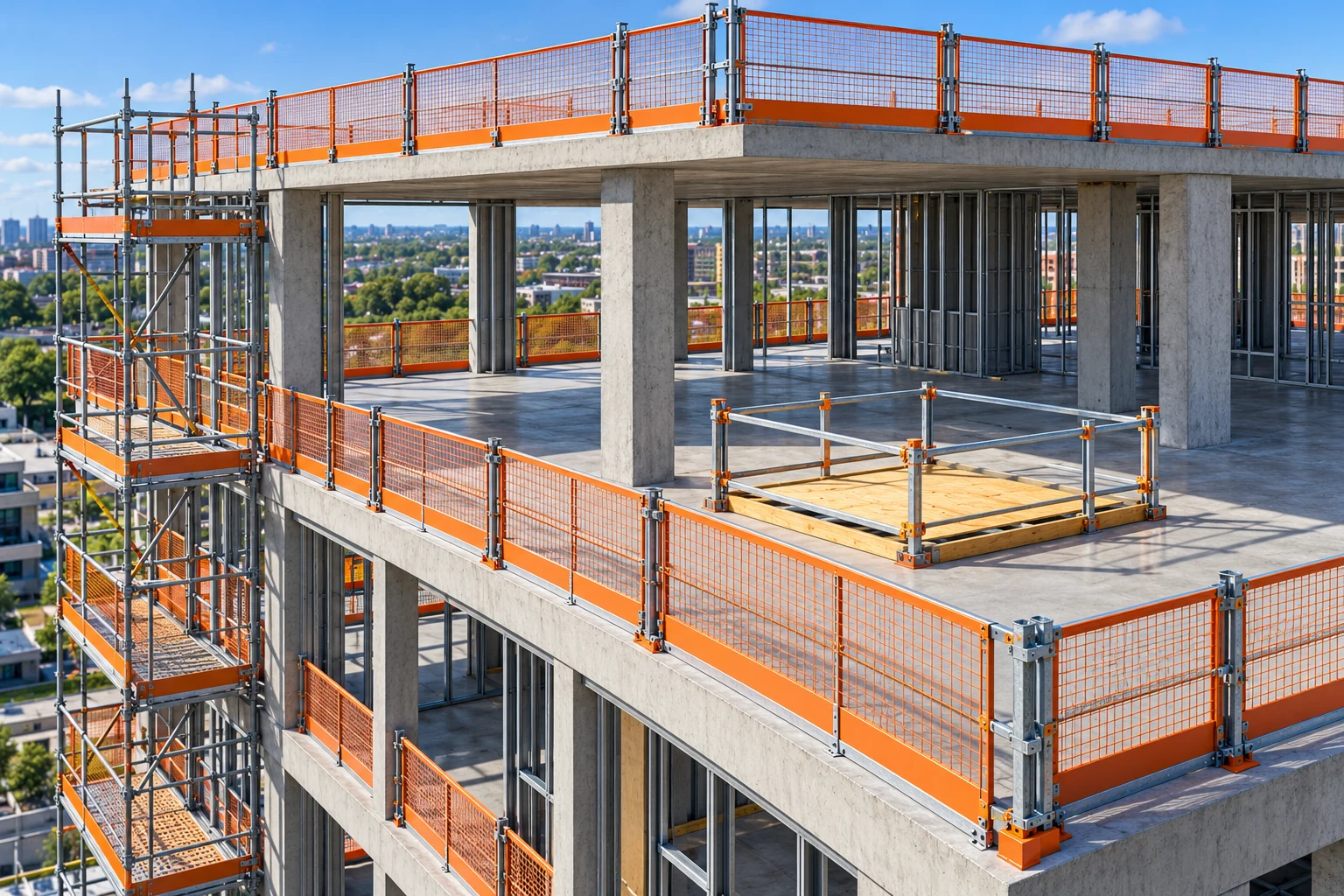
Construction hazards series. These articles cover OSHA’s four construction Focus Four categories plus respirable crystalline silica. They are five major hazards, not a universal statistical ranking. Statistics are labelled by year and scope; US requirements are identified as OSHA requirements.
A roof edge, an uncovered opening or an unsuitable access arrangement can expose a worker to a fall before the main task even begins. Fall prevention needs to be part of planning the work, choosing equipment and preparing access. OSHA’s campaign organises these responsibilities around planning, providing suitable equipment and training. [1]
What is the hazard, and how can it harm people?
The hazard is exposure to a fall to a lower level: for example, from an unprotected edge, through a floor opening or while using access equipment. OSHA’s construction standard addresses these situations separately because the task and working surface affect the required protection. A fall can cause fatal injury. OSHA’s training guide also describes nonfatal falls resulting in head and leg fractures requiring hospitalisation. [7] Preventing the event requires more than a warning to be careful. [1] [2]
What do the statistics show?
This is approximately 37.6%, calculated as 389 ÷ 1,034 × 100. The figures describe the US construction industry in 2024; they are not a global rate, a site-specific probability or a count of all nonfatal falls. [1]
Selected OSHA requirements: height and protection
These are selected US federal OSHA construction provisions. Apply the cited paragraph and its exceptions to the actual work. A height trigger establishes a protection duty; it does not always require a harness as the only permitted solution.
| Situation | Requirement and scope | OSHA reference |
|---|---|---|
| Unprotected sides and edges | On a walking/working surface with an unprotected side or edge 6 ft (1.8 m) or more above a lower level, provide guardrails, safety nets or a personal fall-arrest system. The standard prints 1.8 m as its rounded metric equivalent of 6 ft. | 1926.501(b)(1) [2] |
| Scaffold platforms | The general scaffold rule applies more than 10 ft (3.1 m) above a lower level. The required protection depends on scaffold type. Erectors and dismantlers have separate provisions under paragraph (g)(2). | 1926.451(g)(1)–(2) [8] |
| Holes and dangerous equipment | Protection from stepping or tripping into/through holes requires covers, without a six-foot exemption in that paragraph. Employees less than 6 ft above dangerous equipment require guardrails or equipment guards against falling into or onto it. | 1926.501(b)(4)(ii), (b)(8)(i) [2] |
| Guardrails covered by Subpart M | Top-rail height is 42 in ± 3 in above the working level; the paragraph permits a higher top edge when conditions warrant and all other criteria are met. The height alone does not establish that a rail system complies. | 1926.502(b)(1) [9] |
| Personal fall-arrest systems | Inspect before each use and remove defective components. The employer must provide prompt rescue after a fall or assure self-rescue. | 1926.502(d)(20)–(21) [9] |
Conditions that increase risk—and why
| Risk factor | How it changes the danger |
|---|---|
| Weak surfaces or unsecured covers | A surface may fail under a person, or a cover may move and expose an opening. OSHA requires checking surface strength/integrity and securing covers against accidental displacement. [2] [9] |
| Snow, ice, slippery material or debris | Footing can be lost on a platform, initiating a fall. OSHA prohibits work on slippery scaffolds except as necessary to remove the material and prohibits debris accumulation. [8] |
| Storms and high winds | Wind can affect balance and scaffold stability. OSHA prohibits scaffold work during storms/high winds unless the specific competent-person and protection conditions in (f)(12) are met. No universal wind-speed limit is asserted here. [8] |
| Insufficient fall clearance | A fall-arrest system can be present yet allow impact with a lower level. OSHA requires rigging that prevents contact with a lower level; clearance must suit the complete system and location. [9] |
| Damaged components or no workable rescue arrangement | Damage undermines the intended protective system; an unresolved rescue arrangement leaves the response after a fall unprepared. Pre-use inspection and prompt rescue are explicit OSHA duties. [9] |
Choose controls in hierarchy order
The arrangement below applies OSHA’s control hierarchy to its fall-prevention guidance. The hierarchy grouping is Sentivo’s synthesis, not a quotation of an OSHA five-step fall rule. Specific legal duties still depend on the task and applicable standard. [2] [3]
- Elimination: first ask whether the design or work sequence can remove the need for exposure at height. Consider completing suitable preparation or assembly at ground level, where practicable, rather than accepting an exposed work position as fixed. This is an application of OSHA’s design-led hazard-control approach. [3]
- Substitution: select a safer suitable access or working arrangement for the task. OSHA advises providing the right ladders, scaffolds and safety equipment. Changing equipment does not automatically remove the fall hazard; check the replacement’s suitability and remaining risks. [1] [3]
- Engineering and collective protection: use the guardrails, covers or other protective systems required for the specific situation. OSHA’s requirements distinguish between edges, openings, roof work and other exposures. Do not treat a cover’s mere presence as evidence that it meets the applicable requirements. [2]
- Administrative controls: plan access and work methods, identify the task-specific requirements, train workers and check that selected controls remain effective. A briefing complements the protective system; it does not remove an open edge. [1] [3]
- PPE and personal fall protection: where a personal fall-arrest system is the selected permitted method, provide the correct system and train workers in its use. It must be appropriate to the task and used as a system. A harness alone is not the whole protective arrangement. [1] [2]
Two documented enforcement examples
1. Orchids Builders LLC — Florida
In its 23 July 2026 release, OSHA reported workers exposed to a 10-foot fall while installing roof sheathing on 21 January and a 9-foot fall while installing hurricane clips on 10 March. The release describes two willful and four repeat violations and $349,754 in proposed penalties. These were exposure findings; the release does not report a fall injury in these two inspections. [4]
2. Araujo Construction Corp. — Illinois
OSHA’s 15 September 2026 release describes two investigations involving installation of roof rafters and sheeting without fall protection, with possible falls of up to 25 feet. OSHA proposed $265,868 in combined penalties. That total covers multiple cited hazards, not fall protection alone. [5]
Case summaries describe what OSHA reported at publication. Proposed penalties and contested citations are not final court findings; subsequent case status has not been verified. Images are conceptual illustrations, not photographs of these events.
Before work starts
Sentivo’s review prompt, based on OSHA’s planning and verification guidance: identify the actual fall exposure, confirm the selected protective arrangement and responsible person, and inspect its implementation before access is allowed. Reassess the arrangement when the work or conditions change. [1] [3]
Sources
References were checked on 31 October 2026. Numbered links connect factual claims to these sources. Examples, checklists and proposed applications identified as Sentivo’s are editorial recommendations; they are not quoted requirements or claims of proven results.
- OSHA. Fall Prevention Campaign. (opens in a new tab)2024 US construction fatality figures, planning, equipment selection and training.
- OSHA. 29 CFR 1926.501 — Duty to have fall protection. (opens in a new tab)Task-specific construction fall-protection duties, unprotected sides, holes and protection options.
- OSHA. Hazard Prevention and Control. (opens in a new tab)Hierarchy, safer equipment and design, combined controls and verification.
- OSHA. Florida roofing contractor cited; penalties proposed, 23 July 2026. (opens in a new tab)Orchids Builders, two sites, 10-foot and 9-foot exposures, two willful and four repeat citations, proposed $349,754.
- OSHA. Chicago construction employer cited; penalties proposed, 15 September 2026. (opens in a new tab)Araujo Construction, two investigations, falls up to 25 feet, proposed $265,868.
- OSHA. Construction Focus Four Training. (opens in a new tab)Falls, struck-by, caught-in/between and electrocution as the Focus Four categories.
- OSHA. Construction Focus Four: Fall Hazards, April 2011, pp. 6 and 8. (opens in a new tab)Examples of serious nonfatal falls involving head and leg fractures.
- OSHA. 29 CFR 1926.451 — General requirements for scaffolds. (opens in a new tab)Scaffold fall protection above 10 feet; separate erection/dismantling provisions; slippery surfaces, storms and high winds.
- OSHA. 29 CFR 1926.502 — Fall protection systems criteria and practices. (opens in a new tab)Guardrail criteria, cover security, clearance, pre-use inspection and prompt rescue.