
Hazard control
The hierarchy of controls: look beyond training and PPE
Use the hierarchy to examine how hazards can be removed or controlled, while checking new risks and verifying controls in use.
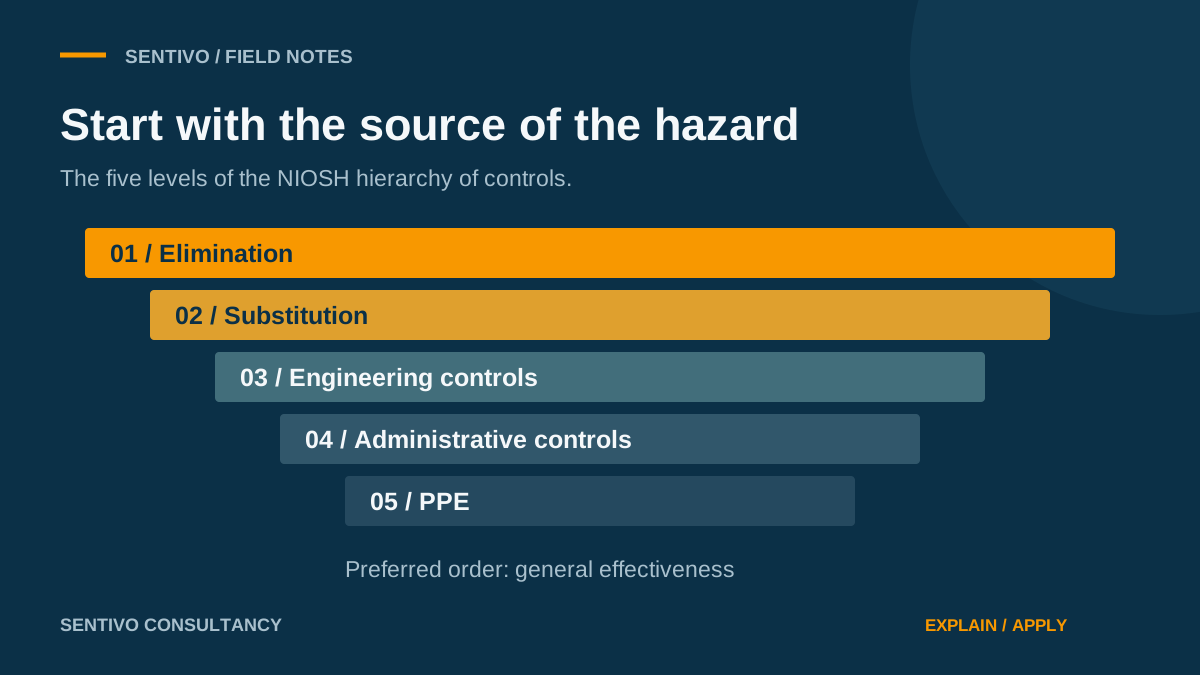
When an assessment identifies a hazard, the action list may quickly fill with instructions: remind workers, repeat training, display a sign and wear PPE. Those actions deserve scrutiny alongside a more fundamental question: can the hazard be removed or controlled earlier?
NIOSH presents five levels of control in a preferred order based on general effectiveness: elimination, substitution, engineering controls, administrative controls and personal protective equipment. [1]
Begin with removal and substitution
Elimination removes a hazard at its source. Substitution uses a safer alternative. NIOSH stresses that a proposed substitute needs review for new risks and interactions with other workplace agents. [1]
Sentivo application: if a process uses a hazardous cleaning chemical, first examine whether the task can be redesigned to avoid it. If a substitute is proposed, assess its hazards and how it will be used. “Different” is not sufficient evidence that the alternative is safer.
Examine engineering controls
NIOSH describes engineering controls as measures that prevent hazards from reaching workers or separate workers from hazards. It explains that elimination, substitution and engineering controls generally reduce exposure with less dependence on human interaction. [1]
For the fictional cleaning task, a design review might examine enclosure or capture at the source. This article does not prescribe a technical solution: suitability depends on the substance, process, exposure and competent design review.
Define the role of administrative controls and PPE
Administrative controls change how people work. PPE provides equipment worn to reduce exposure. NIOSH recognises that both can be effective, while placing them lower in the preferred order. [1]
A procedure, instruction or training session may be part of the control arrangement. It should have a defined purpose: who must do what, under which conditions, and how implementation will be checked. The same clarity is needed for selecting, using and maintaining PPE.
Do not turn the hierarchy into a scoring ritual
NIOSH notes that workplaces may need multiple control methods. [1] Sentivo therefore recommends documenting which options were examined and why the selected combination fits the task. Simply writing a control’s category beside it does not explain its suitability.
A proposed control-review record should identify the hazard, the selected measures, installation or implementation evidence, responsible people and the way performance will be checked. The frequency and method of verification should be agreed for the actual control and operating conditions.
Ask whether training addresses the problem
CDC’s training standards explicitly recognise that training is not always the solution to a gap. [2]
Sentivo application: where a required control is absent or unsuitable, record that issue directly. If workers also need instruction in the revised arrangement, define that learning need separately. This keeps the corrective action connected to the condition that needs to change.
For the next assessment review, Sentivo suggests asking: what higher-level options were considered, what new risks were checked, and what evidence will show that the chosen controls work in the intended setting?
Sources
References were checked on 30 October 2026. Numbered links connect factual claims to these sources. Examples, checklists and proposed applications identified as Sentivo’s are editorial recommendations; they are not quoted requirements or claims of proven results.
- NIOSH. Hierarchy of Controls. (opens in a new tab)The five levels, preferred order, human interaction, substitution risks and the use of multiple controls.
- CDC. Quality Training Standards. (opens in a new tab)Training needs assessment and the recognition that training is not always the solution.