
Training evaluation
How to evaluate HSE training beyond attendance
Separate attendance, learner feedback, assessment and workplace application so the evidence supports the conclusions you report.
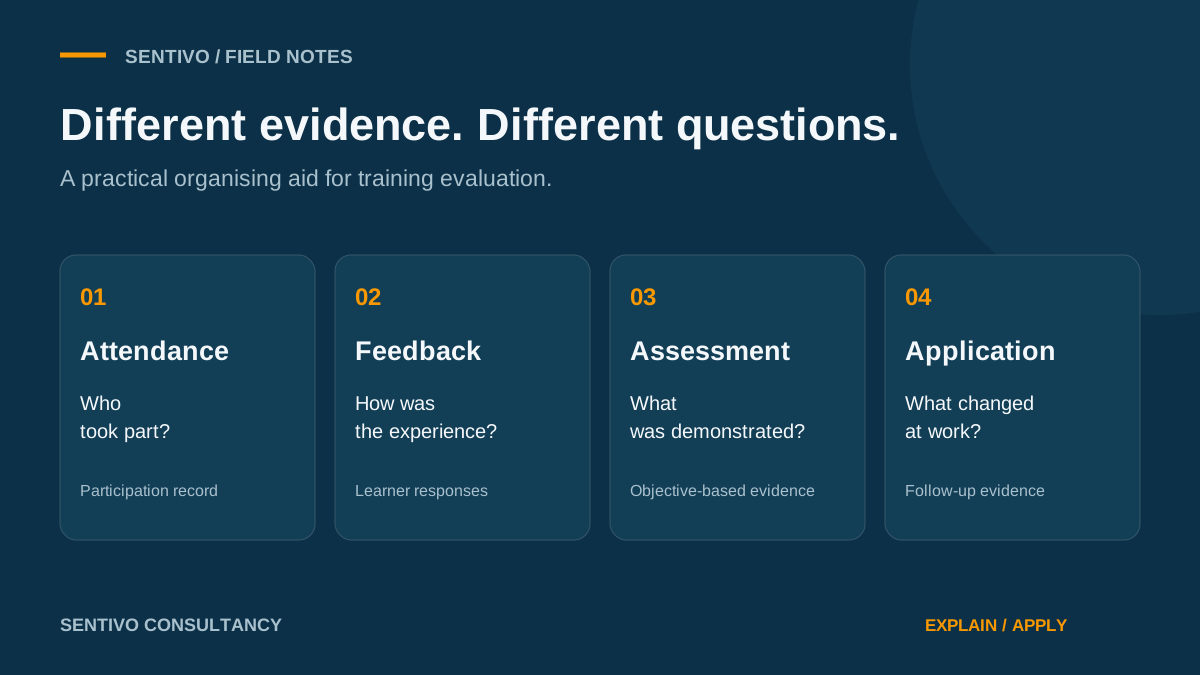
A training report may contain attendance totals, positive feedback and quiz scores. Each can be useful, but they answer different questions. Reporting them together without explaining the distinction can make the conclusion stronger than the evidence allows.
CDC defines training effectiveness in terms of supporting learning and learning transfer: applying what was learned in the workplace. It recommends assessing both where possible. [1]
Decide what you need to know
Sentivo suggests separating four questions in the evaluation plan:
- Who attended or completed the assigned session?
- How did learners experience the training?
- What knowledge or skill did they demonstrate?
- What evidence is available about application at work?
This is an editorial organising method. It is intended to keep different evidence types visible, rather than combine them into an unsupported overall effectiveness score.
Measure learning against the objective
CDC recommends assessments that show whether learning objectives were met. Its guidance explains that pre- and post-training assessment can examine change, while a posttest alone can show end-of-course proficiency without establishing how much was learned during the course. [1]
Sentivo application: if the objective is to identify missing information in a fictional permit request, use a review task and a defined marking guide. A vocabulary quiz can examine terminology, but it should not be presented as evidence of the same practical skill.
Use comparable assessment conditions and explain any differences when interpreting results. A positive score change can inform the evaluation; it should not automatically be reported as proof that the course alone caused the change.
Use feedback for the question it can answer
CDC cautions that learner satisfaction does not determine training effectiveness. It also explains that immediate postcourse feedback cannot objectively establish learning transfer. [1]
Ask about unclear explanations, relevance, access barriers and opportunities to practise. Use these responses to identify improvements. Report satisfaction as satisfaction, alongside the assessment evidence rather than as a substitute for it.
Plan a proportionate workplace follow-up
CDC identifies delayed evaluation as the best way to assess learning transfer. Timing depends on the subject, available resources and the opportunity learners have to apply the learning. Supervisor follow-up may also be appropriate. [1]
Sentivo application: after a group has had a realistic opportunity to use a revised review process, examine a sample of work using agreed criteria. Record the sample, conditions, findings and limits. Ask whether people had access to the necessary documents, equipment and support.
Turn findings into an accurate report
CDC’s standards call for using evaluation findings to improve training and for providing follow-up support. [2]
A proposed report might say: “Participants completed the session; end-of-course assessment met the stated criterion; workplace application has not yet been reviewed.” This wording keeps the conclusion within the available evidence.
Sentivo recommends assigning an owner and date for each improvement action. If learners repeatedly miss the same point, inspect the explanation, activity and assessment wording. If they demonstrate the skill in class but cannot use it at work, investigate the conditions affecting application before deciding that another course is the answer.
Sources
References were checked on 30 October 2026. Numbered links connect factual claims to these sources. Examples, checklists and proposed applications identified as Sentivo’s are editorial recommendations; they are not quoted requirements or claims of proven results.
- CDC. Evaluate Training: Measuring Effectiveness. (opens in a new tab)Learning versus learning transfer, pre/post assessments, satisfaction limits and delayed evaluation.
- CDC. Quality Training Standards. (opens in a new tab)Evaluation planning, objective-aligned assessments, improvement and follow-up support.