
Construction safety
Construction hazards: collapse, entrapment and caught-in/between
Trench cave-ins, unstable structures and moving machinery can trap or crush workers. Examine protective systems, inspections and two documented cases.
Construction hazards series. These articles cover OSHA’s four construction Focus Four categories plus respirable crystalline silica. They are five major hazards, not a universal statistical ranking. Statistics are labelled by year and scope; US requirements are identified as OSHA requirements.
Construction work can place people between moving equipment and fixed structures, beside exposed machine parts or inside an excavation that could collapse. OSHA’s caught-in/between guidance includes these trapping, crushing and engulfment mechanisms. [1]
What is the hazard, and how can it harm people?
A person may be caught in machinery, squeezed between objects or buried by collapsing soil or structures. OSHA identifies outcomes including fractures, amputations and death. Trench collapse is a particular concern because workers can be buried rapidly by large quantities of soil. [1] [2]
These mechanisms need different controls. A trench shield does not address exposed rotating machinery, and machine guarding does not stabilise an excavation. Start with the actual exposure rather than relying on the category name alone. [1]
What do the statistics show?
The guide describes that share as approximately 9% and separately records 16 excavation or trenching cave-in fatalities in that year. These figures are historical and have different scopes: 92 covers the broader category; 16 covers cave-ins. They are not interchangeable or current national estimates. [1]
Selected OSHA requirements: excavation protection and access
These US federal excavation requirements address different hazards. The depth for safe egress is different from the cave-in protection provisions; satisfying one does not satisfy the other.
| Issue | Requirement and scope | OSHA reference |
|---|---|---|
| Cave-in protection | Provide an adequate protective system unless the excavation is entirely in stable rock, or is less than 5 ft deep and a competent person finds no indication of a potential cave-in. A shallow trench is not automatically exempt. | 1926.652(a)(1) [3] |
| Safe egress | In trench excavations 4 ft (1.22 m) or more deep, provide a stairway, ladder, ramp or other safe means of egress requiring no more than 25 ft (7.62 m) of lateral travel. | 1926.651(c)(2) [8] |
| Material or equipment falling/rolling into an excavation | Keep hazardous excavated/other material or equipment at least 2 ft (0.61 m) from the edge, use sufficient retaining devices, or combine these measures where necessary. This is not a universal engineered setback for every plant load or ground condition. | 1926.651(j)(2) [8] |
| Inspection and changing conditions | A competent person must inspect daily, before work, as needed during the shift, and after every rainstorm or other hazard-increasing occurrence where employee exposure can reasonably be anticipated. Remove exposed workers when identified hazardous conditions require precautions. | 1926.651(k)(1)–(2) [8] |
Conditions that increase risk—and why
| Risk factor | How it changes the danger |
|---|---|
| Fissured, disturbed or vibration-affected soil | The ground may be less stable than its initial appearance suggests. OSHA’s soil appendix specifically excludes fissured, previously disturbed or vibration-affected soil from Type A classification. Classification and protection must reflect the actual conditions. [9] |
| Accumulating water or heavy-rain runoff | Water introduces additional excavation hazards and can change the conditions the protective arrangement was selected for. OSHA requires adequate precautions for accumulated/accumulating water and inspection after rainstorms. [8] |
| Plant, spoil or other materials near the edge | Equipment or materials can fall or roll into the occupied excavation; nearby loads also need consideration in the protective-system design. The two-foot materials provision alone does not establish that an excavator can safely stand at that distance. [3] [8] |
| Undermined adjacent structures | Excavation can endanger nearby walls or foundations, creating another collapse mechanism. Where adjoining structures are endangered, OSHA requires support such as shoring, bracing or underpinning. [8] |
| Blocked exit or unguarded machinery | Blocked egress hinders escape from developing danger. Exposed moving machine parts create a separate entanglement/crushing route; they require machinery-specific controls rather than a trench-protection measure. [1] [8] |
Choose controls in hierarchy order
Sentivo groups the OSHA measures below by hierarchy level. The appropriate design and system must be selected for the actual equipment, ground conditions and work. [1] [2] [4]
- Elimination: use OSHA’s design-led approach to ask whether a process can avoid the trapping zone or the need for a person to enter it. For machinery maintenance, prevent hazardous movement through the applicable de-energisation and energy-control arrangements. Stopping a machine without controlling its energy is not equivalent to removing the hazard. [1] [4]
- Substitution: assess a different method or inherently safer equipment where practicable. A proposed alternative must be evaluated for new risks. There is no universal substitute that automatically makes excavation or machinery work safe. [4]
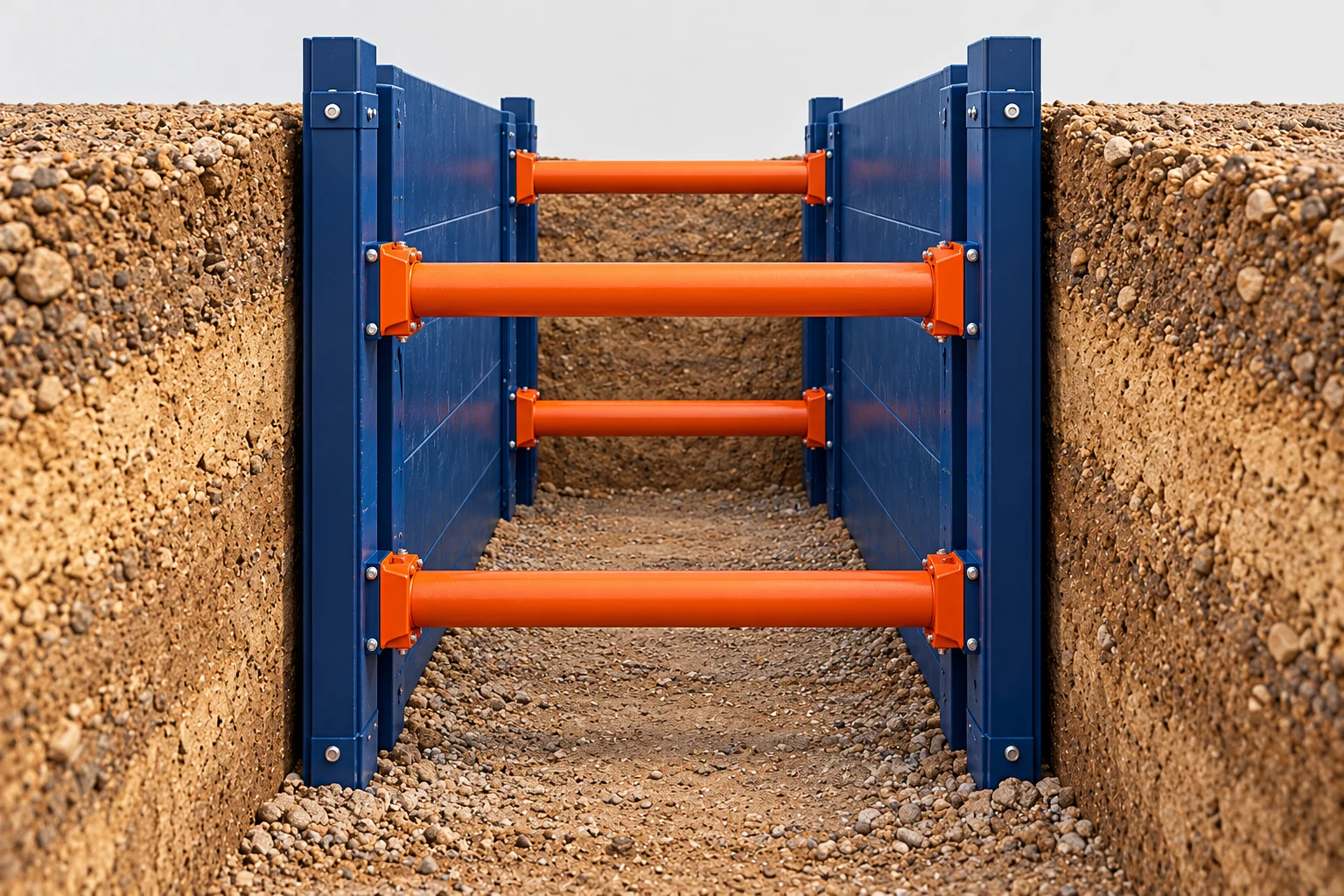
- Engineering controls: provide suitable machine guarding and protection against collapse. For excavations, OSHA identifies sloping or benching, shoring, and shielding as protective approaches. These are alternatives to select and design appropriately, not interchangeable products to install without assessment. [1] [2] [3]
- Administrative controls: arrange competent inspection, safe access and exit, control of materials near edges, and reassessment of water and other changing conditions. OSHA advises never entering a trench unless properly inspected. Training must support the protective arrangements. [2]
- PPE: select task-appropriate protection for residual hazards. Do not treat PPE as the cave-in protective system: OSHA’s cave-in provisions require a suitable protective system unless a stated exception applies. [3] [4]
A critical point about trench depth
Under OSHA 1926.652(a)(1), workers in excavations must be protected from cave-ins unless the excavation is entirely in stable rock, or it is less than five feet deep and a competent person finds no indication of a potential cave-in. “Less than five feet” is therefore not a blanket exemption from assessing collapse risk. These are US federal OSHA provisions, not a universal international threshold. [3]
Two documented real accidents
1. J.D. Wagoner Excavating — Pennsylvania
In a 7 October 2026 release, OSHA described workers installing a storm sewer in a 12-foot-deep inadequately protected trench. A wall failed and soil engulfed a worker, causing fatal injury. OSHA reported beginning its investigation on 2 April 2026; that is the investigation date, not an independently verified accident date. The agency proposed $254,884 in penalties. [5]
2. Blazey Construction Services LLC — Texas
OSHA’s 15 July 2026 release describes an excavation collapse during sewer and water-pipe installation for a residential development in Alvin. A worker was hospitalised. OSHA reported inadequate excavation protection, unsafe egress and a reporting failure, with $343,797 in proposed penalties. The total covers those findings collectively. [6]
Case summaries describe what OSHA reported at publication. Proposed penalties and contested citations are not final court findings; subsequent case status has not been verified. Images are conceptual illustrations, not photographs of these events.
Before allowing entry
Sentivo’s suggested verification prompt is to identify the trapping or collapse mechanism, the protective system, the competent inspection and the safe exit route. Confirm the controls at the location where people will actually work, and stop to reassess when conditions change. [1] [2] [4]
Sources
References were checked on 31 October 2026. Numbered links connect factual claims to these sources. Examples, checklists and proposed applications identified as Sentivo’s are editorial recommendations; they are not quoted requirements or claims of proven results.
- OSHA. Construction Focus Four: Caught-In or -Between Hazards, Instructor Guide, April 2011, pp. 4–8 and control sections. (opens in a new tab)Hazard definitions, injury mechanisms, historical 2008 counts, machinery and collapse controls.
- OSHA. Trenching and Excavation. (opens in a new tab)Slope, shore, shield; access, materials, environmental hazards and inspection.
- OSHA. 29 CFR 1926.652 — Requirements for protective systems. (opens in a new tab)Cave-in protection duties and the stable-rock and under-five-feet exceptions.
- OSHA. Hazard Prevention and Control. (opens in a new tab)Hierarchy, design-led prevention, combined controls and effectiveness checks.
- OSHA. Pennsylvania excavation employer cited following fatal trench cave-in, 7 October 2026. (opens in a new tab)J.D. Wagoner Excavating, fatal engulfment in 12-foot trench, proposed $254,884.
- OSHA. Houston utility contractor cited following excavation collapse, 15 July 2026. (opens in a new tab)Blazey Construction Services, hospitalised worker, egress and protection findings, proposed $343,797.
- OSHA. Construction Focus Four Training. (opens in a new tab)The Focus Four construction categories.
- OSHA. 29 CFR 1926.651 — Specific excavation requirements. (opens in a new tab)Egress at four feet, 25-foot lateral travel, edge materials, water, adjacent structures and competent-person inspections.
- OSHA. 29 CFR 1926 Subpart P, Appendix A — Soil Classification. (opens in a new tab)Fissures, disturbance, vibration, soil classification and changing conditions.