
Construction safety
Construction hazards: electricity and electrocution
Overhead lines, damaged leads and energised equipment can kill. Prioritise de-energisation, suitable protective arrangements and verification.
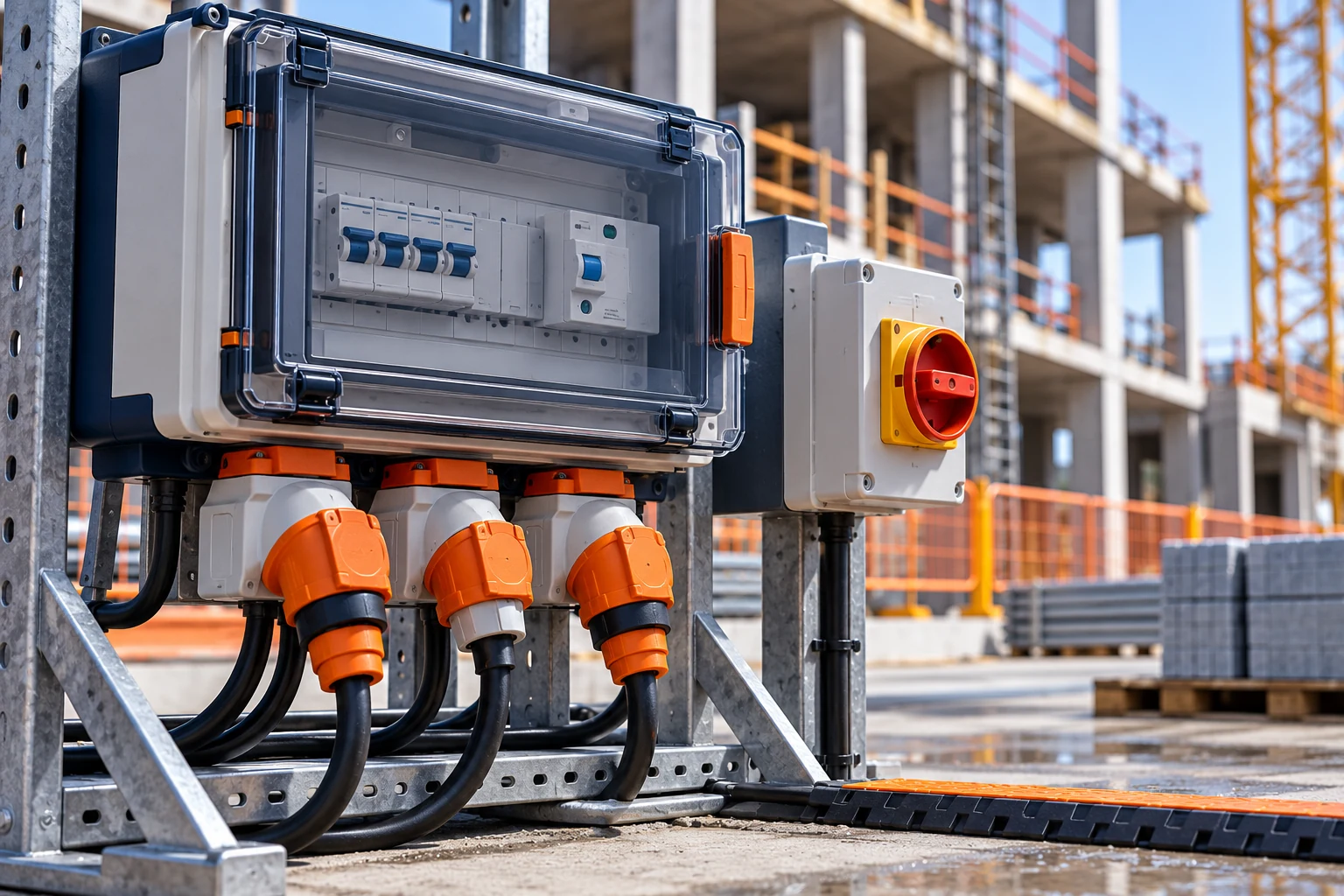
Construction hazards series. These articles cover OSHA’s four construction Focus Four categories plus respirable crystalline silica. They are five major hazards, not a universal statistical ranking. Statistics are labelled by year and scope; US requirements are identified as OSHA requirements.
Electrical exposure can arise while operating plant near overhead lines, using portable tools or working on equipment. The person harmed need not be performing an electrical installation: OSHA’s construction examples include workers using access equipment and powered tools. [1]
What is the hazard, and how can it harm people?
The hazard is contact with, or hazardous exposure to, electrical energy. OSHA’s guidance addresses electric shock, electrocution, burns and falls associated with electrical incidents. Electrocution means a fatal outcome; it should not be used as a synonym for every electric shock. [1] [2]
Damaged insulation, unsuitable cords, missing grounding paths and proximity to overhead lines are among the exposures OSHA identifies. Before work starts, the applicable construction requirements call for establishing whether electrical circuits could expose workers to danger and providing the necessary protection. [1] [3]
What do the statistics show?
This is historical context, not a current estimate. A newer national electrical-fatality figure was not verified from the permitted sources for this article, so the old figure is not presented as today’s rate. For a recent, narrower measure, OSHA’s March 2026 Primoris release reports one worker killed and two hospitalised in a single August 2025 event. A case count is not a national statistic. [2] [5]
Selected OSHA requirements: electrical contact and protection
These are US federal construction provisions. The required protection depends on the circuit, equipment and operation; no single clearance or portable-device rule covers every electrical task.
| Issue | Requirement and scope | OSHA reference |
|---|---|---|
| Possible electrical contact during work | Protect workers who could contact a circuit by de-energising and grounding it, or by effective guarding through insulation or other means. Before work, determine whether exposed or concealed energised circuits could contact a person, tool or machine; provide the specified warnings and information. | 1926.416(a)(1), (a)(3) [3] |
| Construction-site ground-fault/grounding protection | Use the specified GFCI approach or an assured equipment-grounding conductor program meeting the rule. These requirements are additional to other equipment-grounding conductor duties. | 1926.404(b)(1)(i) [7] |
| Scope of the GFCI option | It covers employee-used 120 V, single-phase, 15 A and 20 A receptacle outlets on construction sites that are not part of permanent wiring. Paragraph (ii) contains a narrowly defined portable/vehicle-mounted generator exception; it is not an exemption for all generators. | 1926.404(b)(1)(ii) [7] |
| De-energised equipment and circuits | Render them inoperative and attach tags at all points where they can be energised. A tag must plainly identify the equipment/circuit being worked on. Apply the complete relevant energy-control arrangements; this is not a claim that tagging alone establishes safe isolation. | 1926.417(b)–(c) [8] |
Conditions that increase risk—and why
| Risk factor | How it changes the danger |
|---|---|
| Damaged insulation, altered cords or a missing grounding path | A fault can energise exposed conductive equipment while the intended protective path is absent. OSHA’s eTool describes fatal incidents involving these combinations. [1] |
| Wet work areas and unsuitable equipment use | Moisture can form part of the shock-exposure circumstances; OSHA’s accident examples include wet conditions, damaged/unsuitable leads and equipment left in service despite shocks. A reported shock calls for resolving the defect, not continued use. [1] |
| Unidentified overhead or concealed circuits | Workers may bring tools, plant or materials into contact without recognising the electrical source. OSHA requires checking for such circuits before work and informing affected workers. [3] |
| Unexpected energisation | A circuit believed to be off can become live if energisation points are not controlled. Rendering equipment inoperative and identifying those points addresses this failure route. [8] |
| Pole/plant movement near energised lines | Moving equipment or a pole can bridge the intended separation. The Primoris case illustrates why the actual approach-distance arrangements, observer duties and briefing need to match the operation. [5] |
Choose controls in hierarchy order
The hierarchy below is Sentivo’s organisation of OSHA guidance. Electrical work requires competent planning and the standards applicable to the actual operation; a generic checklist cannot authorise live work. [3] [4]
- Elimination: prioritise removing the electrical exposure through de-energisation and the applicable energy-control and verification arrangements. Do not assume that a switch position or a verbal assurance establishes a safe condition. OSHA’s guidance specifically addresses de-energisation and protection against hazardous electrical contact. [1] [2] [3]
- Substitution: consider an inherently safer suitable tool or equipment choice under OSHA’s design and equipment-selection approach. A different power source can introduce other hazards and does not make the complete work area safe automatically. [4]
- Engineering controls: use the required guarding, insulation, grounding and ground-fault protection for the application. OSHA identifies ground-fault circuit interrupters as a protective measure, but they do not replace de-energisation or establish a safe distance from overhead lines. [1] [3]
- Administrative controls: identify circuits and overhead lines, plan work and equipment movements, brief affected workers, inspect portable tools and leads, and remove defective equipment from use. Approach distances depend on the applicable rule, voltage and operation; this article deliberately gives no single universal distance. [1] [3] [5]
- PPE: provide electrical protective equipment where required and ensure its suitability and condition. PPE is part of the protective arrangement where applicable; it does not justify omitting required de-energisation or isolation. [2] [4]
Two documented real accidents
1. Primoris T&D Services LLC — Florida utility construction
OSHA’s 13 March 2026 release states that a crew replacing a pole in August 2025 contacted an energised overhead transmission line. A lineman was electrocuted and two other workers were hospitalised. OSHA cited three serious violations and proposed $49,650 in penalties. The release explicitly states that the employer contested the citations. [5]
2. Drywall work with a modified power lead
OSHA’s eTool describes a worker receiving a fatal shock while cutting drywall with a metal-cased router. A three-wire tool cord had been spliced to a two-wire cord and plug unsuitable for hard service. OSHA reports a fault, no grounding and no GFCI protection. The summary supplies no accident date or employer name; none is added here. [1]
Case summaries describe what OSHA reported at publication. Proposed penalties and contested citations are not final court findings; subsequent case status has not been verified. Images are conceptual illustrations, not photographs of these events.
Before the job proceeds
Sentivo’s verification prompt is to confirm the energy source, the protective method, the person responsible for establishing the safe condition and the checks required before work. Treat changed conditions or uncertainty about energisation as a reason to stop and resolve the exposure. This applies OSHA’s control-selection and effectiveness-review principles. [3] [4]
Sources
References were checked on 31 October 2026. Numbered links connect factual claims to these sources. Examples, checklists and proposed applications identified as Sentivo’s are editorial recommendations; they are not quoted requirements or claims of proven results.
- OSHA. Construction eTool — Electrical Incidents. (opens in a new tab)Electrical hazards, injury routes, overhead lines, GFCIs, cords and anonymised drywall-router fatality.
- OSHA. Construction Focus Four: Electrocution Hazards, Instructor Guide, April 2011, p. 5 and control sections. (opens in a new tab)Historical 2005 US construction statistics and protective arrangements.
- OSHA. 29 CFR 1926.416 — General requirements. (opens in a new tab)Protection from electrical contact, locating circuits and warning affected workers.
- OSHA. Hazard Prevention and Control. (opens in a new tab)Control hierarchy, safer equipment selection and checking effectiveness.
- OSHA. Florida construction contractor cited after electrocution and injuries, 13 March 2026. (opens in a new tab)Primoris T&D, August 2025 pole-contact incident, one fatality and two hospitalised workers, proposed $49,650 and contested citations.
- OSHA. Construction Focus Four Training. (opens in a new tab)Electrocution as a construction Focus Four category.
- OSHA. 29 CFR 1926.404 — Wiring design and protection. (opens in a new tab)Construction-site GFCI or assured equipment-grounding conductor program; defined receptacle scope and limited generator exception.
- OSHA. 29 CFR 1926.417 — Lockout and tagging of circuits. (opens in a new tab)Rendering de-energised equipment/circuits inoperative and tagging energisation points.