
Adult learning
Adult learning principles that HSE trainers can apply
Make learning relevant, draw on experience, provide practice and use feedback without relying on learning-style labels or invented retention percentages.
An experienced worker may recognise a hazard immediately and still need help applying a revised procedure. A new worker may know the terminology but have little experience interpreting a real task. A useful training plan makes room for both situations.
OSHA’s worker-training guidance emphasises relevance, respect for experience, participation and practice. CDC adds requirements for suitable examples, feedback and accessible learning materials. These are design principles to apply thoughtfully, rather than assumptions that all adults have identical needs. [1] [2]
Show why the learning matters
OSHA recommends relating training to workers’ needs and practical work. [1]
Sentivo application: open a job-hazard-analysis lesson with a short fictional task: the work location has changed after the assessment was prepared. Ask what information must be reviewed before proceeding under the applicable procedure. The question gives the lesson a workplace purpose. Explain the objective and what learners will be asked to demonstrate.
Use experience as material for discussion
OSHA encourages acknowledging learners’ experience and enabling exchanges between participants and facilitators. [1]
Ask participants where a procedure has been difficult to interpret. Compare the examples with the approved source material. Experience can reveal useful questions, but a familiar practice should still be checked against the relevant requirements. This comparison is Sentivo’s proposed way to use experience without treating it as automatic proof of correctness.
Make participation purposeful
CDC lists case studies, knowledge checks, questions and exercises as possible engagement methods, selected for learners’ needs and training goals. It also calls for opportunities to receive feedback. [2]
A practical activity should require the target skill. If the objective is to recognise an incomplete work request, ask learners to review one. A general discussion about the importance of safety may be relevant, but it does not directly demonstrate that skill.
Provide practice and revisit key decisions
The National Academies’ research synthesis discusses retrieval and spaced practice as strategies that can support learning and retention. These findings do not establish a single best schedule for every HSE course. [3]
Sentivo application: after explaining a decision rule, ask learners to apply it without copying the answer. Give corrective feedback. Revisit the same principle later using a different scenario. Agree follow-up timing around when learners will have a realistic opportunity to use the skill.
Remove avoidable participation barriers
OSHA addresses language and literacy needs; CDC’s standards address usability and accessibility. [1] [2]
Before delivery, check whether participants can read the materials, hear instructions and use the response method. For a remote session, offer an alternative to speaking aloud where practical. For technical wording, explain the term and verify understanding through application.
A trainer’s planning question
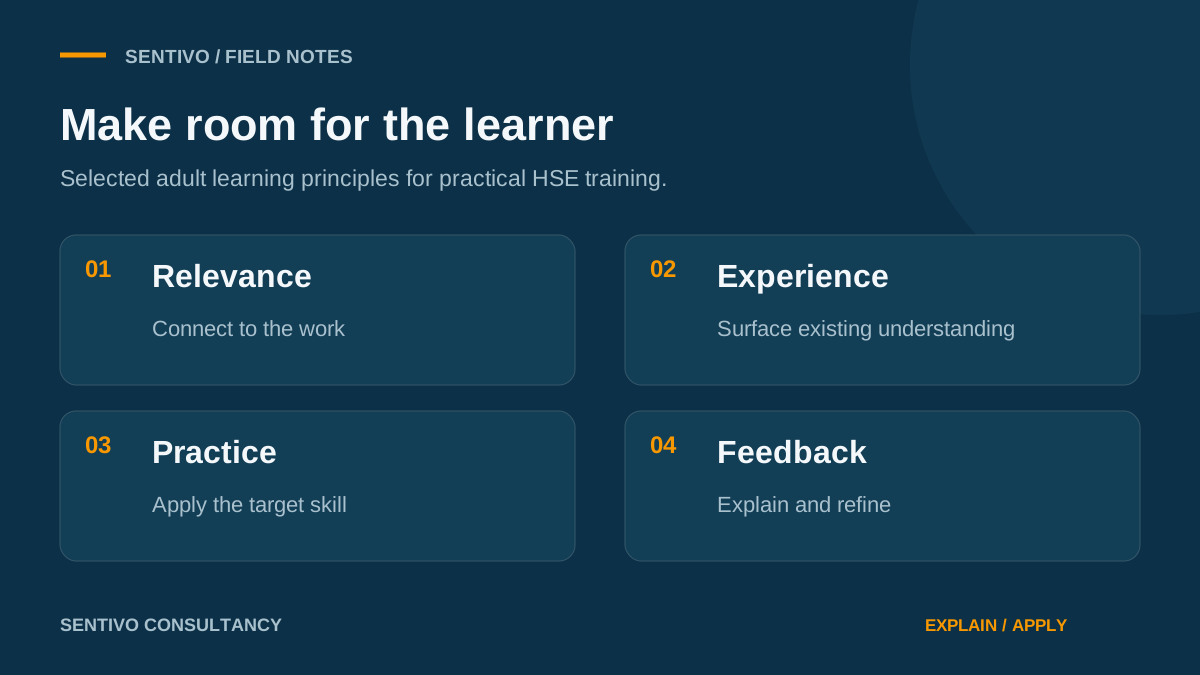
Sentivo suggests reviewing each lesson with four questions: why is this relevant, what experience can learners bring, what will they practise, and what feedback will they receive? Record the answers in the delivery plan. The purpose is to make learning decisions explicit and reviewable.
Sources
References were checked on 30 October 2026. Numbered links connect factual claims to these sources. Examples, checklists and proposed applications identified as Sentivo’s are editorial recommendations; they are not quoted requirements or claims of proven results.
- OSHA (2015). Resource for Development and Delivery of Training to Workers, OSHA 3824, pp. 3–11. (opens in a new tab)Relevance, respect for experience, active participation, practice and language/literacy considerations.
- CDC. Quality Training Standards. (opens in a new tab)Relevant examples, engagement, feedback, accessibility and follow-up support.
- National Academies of Sciences, Engineering, and Medicine (2018). How People Learn II, Chapter 5: Knowledge and Reasoning. (opens in a new tab)Research synthesis on retrieval, spaced practice and applying knowledge in new situations.